
Last Updated on August 3, 2026
…suggestions on what to see, do & eat in the “Pink Granite Coast” hub
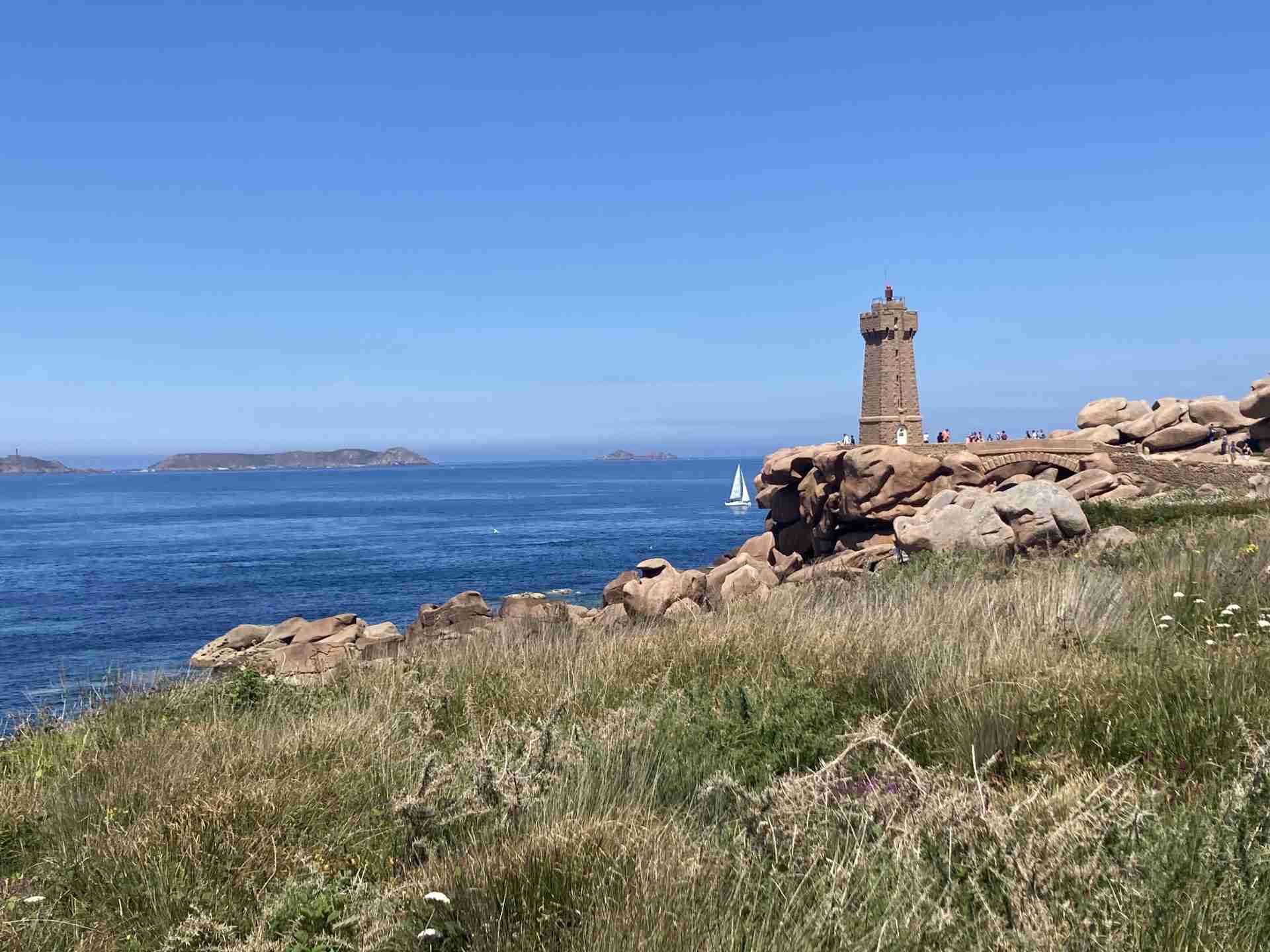
It’s already been a couple of years since I and my little family spent a week in Perros-Guirec, a town situated on the “Pink Granite” coast in Brittany’s Côte d’Armor region. I’m just now starting to sift through reams of notes and hundreds of photos, as I prepare to drop a longer (free) guide to the area here at Paris Unlocked. So stay with me as I recall a few brief highlights from a part of Brittany that feels quite different from others I’d explored in the past.
For one, the landscapes were surprisingly warm and colorful: a far cry from the dramatically craggy, rain and wind-beaten terrains of the extreme Atlantic coastal areas. You know— think neatly painted blue and white lighthouses standing triumphantly against crashing waves and grey skies.
Perros and the surrounding coastal area was a refreshing contrast to those familiar Bréton scenes (as much as I’ve often relished in their crashy-waves-and-bleak-lighthouse vibes). As its name suggests, the Côte du Granit Rose is characterised by landscapes studded with warm pinkish granite, often transparent, gentle blue waters and wide, fine-sanded beaches.
The Walks & Beaches

Chief among the interesting ways to explore the area is walking along its many (mostly gentle) coastal hiking trails. The Côte du Granit Rose stretches for more than 30 km/18 miles on the northern coast of Brittany (along the English Channel), from Plestin-les-Grèves to Louannec. It’s well-known for its temperate conditions, family-friendly beaches, and islands with abundant wild bird colonies, including puffins, cormorants and terns.
We explored the Perros-Guirrec and Ploumanac’h stretch of the coast, which is one of the most popular among tourists due in part to the many lodging, public transport and dining options in the area.
One hike we liked so much that we did it twice was from Perros-Guirrec’s main beach to Ploumanac’h. This is an easy- to-moderately challenging trail that skirts the coastline and offers memorable views of cliffs and unusual rock formations in warm pink or salmon; small lighthouses perched on rocky bluffs, quiet pebble beaches with transparent waters, and sailboats drifting placidly along the coast are all common sights along the way.

The trail (GR34) is also known as the sentier des douniers or “custom officers’ trail”, owing to its history of customs controls along a coast that was once notorious for smugglers illegally importing counterfeit goods. It’s easy to see how some of the quieter, rocky beaches would make perfect smugglers’ coves…
At a gentle pace, the walk between Perros-Guirec’s Trestraou Beach (a fine-sand, built-up beach ideal for families) and the “Saint-Guirec” beach in Ploumanac’h only takes around 2.5 to 3 hours; you can also hop on a local shuttle bus to a desired stop along the way, then walk just part of the route (see more on transportation below).
Ploumanac’h Beach and town is an ideal place to stop for a swim in the lagoon-like waters, and there are plenty of inexpensive restaurants to try for lunch. Ice cream or sorbet from the local vendor in the village right behind the beach is also a welcome treat on a hot day, post-hike.

Another nice walk we tried was around Trégastel, in a peninsula-shaped coastal area known as the “Ile Rénote”. Here, on a gentle trail stretching for just over 2.1 km/1.3 miles, the paths are flanked with soft ferns and flowering marine plants; in beachy stretches below you can explore pink-hued boulders, tidepools and marshy landscapes.
At low tide the boats and small sailboats almost appear to sink in the sandy bed of the English channel, and then bounce back up when the high tide comes in.

Even at only two and a half, my daughter delighted in clamboring up the (small) pink-hued boulders, spotting tiny, gelatinous-looking green crabs and other creatures in the tide pools, bird-watching, and admiring how the light hit the water and sand at different moments of the day, casting intricate shadows.
Getting Around as a Walker: There’s a very handy, year-round shuttle bus service called “Le Macareux” (The Puffin) that stops at various points along the route, so once in Perros renting a car isn’t even a necessity if you’re happy to stay in a fairly circumscribed area. In the summer, the shuttle runs every day and costs (at the time of writing) 1.40 Euros per rider; during the school year it’s free, but only runs on Monday, Wednesday, and Friday mornings and on Wednesday afternoons
(which are market days in Perros-Guirec and Trégastel).
The Old Church in Perros: Eglise Saint-Jacques

While Perros has a history stretching back thousands of years, visually and architecturally it mostly resembles a 19th-century French resort town. But one stunning medieval edifice worth visiting in central Perros (Place de l’Eglise) is the Eglise Saint-Jacques.
Its odd facade arises from the fact that one half of the structure is Romanesque (11th-century) and the other is 14th-century Gothic. It’s certainly one of the more structurally interesting medieval churches I’ve seen in France (and I’ve seen a lot of them).
Inside, if you’re lucky you might hear the inspired playing of one of the organists, and on a hot summer day the cool stone walls and delicate stained glass feel like a real refuge.
Trégastel Market

Another stop I highly recommend is the large farmer’s and clothing market at Trégastel, a town along the coast and just a 12-minute drive from Perros along the (easy-to-navigate) Route de Lannion. There are also local “Macareux” shuttle buses serving Trégastel from Perros-Guirec and back.
Running every Monday morning year-round, the market is lively and pleasant, and offers what seems to be a fairly authentic picture of local and regional life. You’ll find dozens of stands selling everything from fresh produce to bulk spices, cheeses to scarves and knitware. There are also several decent restaurants on the edges of the market, so I recommend hitting the market then having lunch in— or heading to the nearby beach and picknicking with whatever you procure.

Eating & Drinking: A Few Suggested Stops
As you might imagine, crepes and creperies are the star dish in this region, and I’d estimate that something like two or three out of five restaurants in Perros serve crepes and Breton-style galettes (buckwheat pancakes) along sturdy bolets (roundish wooden bowls) of traditional cider. Especially if you’re not a big meat eater, this will be your main option for sustenance, which might get a bit tiring if you’re here for more than a few days.
Still, if you decide to embrace the crepe and galette in all their (charming?)ubiquity, you may as well choose some of the better places for lunch or dinner.
By far, the most delicious crepes and galettes we tasted were at Ty Breizh, situated right on the Perros Port/Harbour (1 Rue de Landerval, 22700 Perros-Guirec; booking in advance is recommended). Here, both the savory and sweet options were universally delicious and the casual, relaxed vibes were perfect with a two-year old along for the meal. We ended up taking my parents in law there for dinner after enjoying lunch there a first time.

While I’m mostly vegetarian, I eat a bit of fish and shellfish, especially in France where veggie options can be (ehem) pretty limited. The leek and scallop savory galette was, I thought, a marvel: the scallops perfectly braised, the leeks delicate, buttery and melting, and the buckwheat pancake itself hearty but not stodgy.
On the savory side, there’s one vegan option available (a “ratatouille” galette), which was tasty but not quite filling enough, in my book. It’s also possible to pretty much make any savory galette vegetarian upon request, and the staff (in our case, at least) were nice about it.
I’m still dreaming about the salted Breton caramel crepe I ordered both times for dessert, topped with caramelized apples, “palet bréton” biscuit ice cream and a mini “kouign amann” butter pastry (a local specialty I highly recommend you sample from as many local bakeries as possible, by the way). It’s as good as it looks— promise.

Another creperie we liked in the center of Perros-Guirec (more convenient for where we were staying) was Les Calculots (1 rue du Général de Gaulle), just across from the aforementioned Eglise Saint-Jacques. The service was quick and friendly, the spacious terrace was ideal for an evening summer meal, and both sweet and savory options were hearty and tasty.
{Related at Paris Unlocked: Crepe Restaurants We Recommend in Paris}
Meanwhile, for “inland” drinks & casual pub fare, try a night out at Digor Kalon (89 Rue du Maréchal Joffre), a funkily decorated Breton-style bar and pub on a side street in Perros that’s distinctively un-touristy.
Lovingly and weirdly appointed with mismatched antique furniture, old pots and pans suspended from the ceiling, posters, books, candles and other “bric a brac”, the pub serves food that’s perfectly serviceable (and no crepes in sight!).

The drinks are inexpensive, and the vibes are friendly and entirely un-fussy. Part of what I love about Bréton culture writ large: it tends to eschew the snobbery that reigns in certain places elsewhere, especially in Paris.
Lastly, I would be remiss if I didn’t mention that Perros boasts an unusual number of excellent food shops (epiceries) where you can stock up on Breton goodies like kouign amann butter cakes, palet bréton biscuits and other specialties, as well as procure a hunk of the much-fussed-over Bordier butter in different flavors, from simply salted to yuzu or vanilla.

If you have access to a refrigerator at your hotel or holiday rental, I strongly suggest getting some of this Breton-produced butter and slathering it generously on a baguette tradition or hearty chunk of pain de campagne (a large, round wholemeal sourdough-style bread).
Two local gourmet foodshops I recommend in central Perros are the Epicerie Aux Quatre Saisons (18 Rue du Général de Gaulle) and Chez Babeth l’Epicerie (17 Place de l’Eglise).
One word of warning: after a week in this region I had to take a long break from butter. I honestly think I ingested more butter that week than I had in half my lifetime. Non, je ne regrette rien…
Getting to Perros-Guirec: Some Quick Tips
Perros-Guirec is, well, not that easy to get to, as we unfortunately discovered. High-speed TGV trains operated by national rail company SNCF run regularly from Paris Montparnasse station to Rennes (a major hub in Brittany); you’d then be best off catching a regional train to Lannion and picking up a rental car there. If you don’t drive at all, it’s essential to reserve a taxi from Lannion in advance, booking it for around the time your train is expected to arrive from Rennes.
There are no onward trains from Lannion to Perros-Guirec; the latter has no train station these days. And as we discovered, relying on local taxis to get around the region can be very hit-and-miss; when we arrived in Lannion, exhausted after hours of train travel, we found no taxis heading to Perros-Guirec and our holiday rental house were available. We waited for two hours at the train station, despairing a bit— and in retrospect wished we had elected to pick up our rental car in Lannion rather than on the outskirts of Perros. Lesson learned…
See more on the Pink Granite Coast region, including info on hotels, hiking trails, restaurants and other essential info, at the official tourist office website.
More From Around France

Inspiring French Christmas Traditions to Enjoy at Home or Abroad
Inside Strasbourg’s “Aubette 1928”, a Riveting Avant-Garde Experiment With Space

Protected: A Week in Paris, Versailles & Reims: A Self-Guided Itinerary

Protected: A 10-Day Adventure in Paris & Lyon (Self-Guided Itinerary)

Protected: 1 Week in Paris, Plus Chartres Cathedral: A Self-Guided Itinerary

10 French Stereotypes & Myths About Parisians to Ditch Now

Courtney Traub is the Founder and Editor of Paris Unlocked. She’s a longtime Paris resident who now divides her time (as well as she can manage) between the French capital and Norwich, UK. Co-author of the 2012 Michelin Green Guide to Northern France & the Paris Region, she has been interviewed as an expert on Paris and France by the BBC, Australian Broadcasting Corporation, Le Figaro, Matador Network and other publications. Courtney has also written and reported stories for media outlets including Radio France Internationale, The Christian Science Monitor, Women’s Wear Daily and The Associated Press. In addition to going down various rabbit holes of curiosity when it comes to French culture, history, food and art, Courtney is a scholar of literature and cultural history whose essays and reviews have appeared in various forums.
