
Last Updated on July 23, 2026

In 2022, UNESCO recognized the French baguette as a prized item of “intangible cultural heritage“. The global organization lauded the “artisanal know-how and culture of baguette bread”, adding yet another notch to France’s status as a capital of culinary expertise and history.
One might assume that this much-loved, elongated loaf has been in existence for centuries– surely it must be a tradition whose conception is too historically remote to remember?

But despite the fact that an estimated 30 million of these breads are consumed each day in France, the baguette is a relatively recent addition to the country’s proud culinary stable. In this (very) brief history of the French baguette, I attempt to separate myths from facts, and to learn how the humble loaf came to conquer daily life in France– then the world.
First, the myths and origin stories…
Despite training as a journalist during an internship with the Associated Press– an organization that’s legendary for its dedication to the facts– I always think it’s more amusing to start with the apocryphal (mythic, rumored) before turning to the verifiably true.
And when it comes to la baguette, fun origin stories abound. At least three of these are still being widely circulated:
1. Napoleon commissioned the baguette’s creation to feed his hungry troops.

Ok, let’s get one thing out of the way. It is true that Napoleon Bonaparte was preoccupied by a need to properly feed his “exhausted” troops during the disastrous Russia campaign of 1812. According to one historian, he laid claim to 100,000 rations of bread for his freezing and hungry soldiers, warning that “anarchy and violence would reign” if they did not receive the provisions.
Some have claimed that Napoleon specifically ordered his personal baker to create a baguette-shaped loaf that would be quicker to bake in the oven, lighter and easier to transport, since soldiers might even have been able to carry them in their pockets as they traveled.
In his 1825 book The History of Napoléon and the Grand Army of 1812, the historian Philippe de Ségurd recounts that the Emperor visited the ovens of his personal baker every day, to “taste the bread and ensure the regularity of all its distributions”.
Available evidence does show that Napoleon was (obviously) concerned about getting his troops enough sustenance, and may even have consulted with his baker to create some form of bread more suitable for the battlefield.
But in scouring the two long tomes of Ségur’s history for the word “pain” (bread), I found no specific mention of elongated loaves, nor of Napoléon commissioning breads differently shaped from those that would have been ordinarily made at the time.
In short, the baguette we know and love today was not at all likely to have been the brainchild of the Emperor or his boulanger.
For one, the modern baguette is made in a steam oven…which brings us to myth #2.
2. The Austrian guy who most likely invented the “French” croissant is also the brains behind the baguette.

Another common origin story has it that August Zang, the Austrian baker and Parisian transplant who is very likely to have invented the French croissant au beurre in his steam oven sometime around 1837, also created an elongated loaf of bread that would become the baguette.
But this is probably overstated, at the least. While Zang did introduce the modern steam ovens that would be widely adopted by French boulangers for the baking of baguettes in the 20th century, there’s no real evidence that breads bearing the precise shape, composition and weight of today’s baguettes appeared at any point in France during the 19th century.
Zang and his co-owner at “La Boulangerie Viennoise” (storefront pictured above) did reportedly bake oval-shaped loaves in a style that ostensibly resembled certain traditional Austrian breads.
In short, while it would have been a real coup for Zang to devise two of France’s most ubiquitous modern bakery staples, he can’t claim that mantle. Nein, tut mir leid (nope, sorry). Nevertheless, he can be credited with introducing the oven (and baking technique) that would eventually make the baguette possible.
3. Bakers devised the baguette for the workers who built the Paris Metro, around 1900.

The third and final popular baguette origin story shares some similarities with the Napoleonic battlefield myth, in that it features a baker supposedly commissioned to create breads tailored for a specific group of workers. According to this legend, the baguette was devised in the early 1900s, as construction for the Paris Metro was underway.
The massive project required workers from around France, and this often led to cultural and regional tensions; rumor had it that major fights kept breaking out between workers from, for example, Brittany and the Auvergne.
Amid all the quibbling, project managers for the Paris Metro supposedly asked local bakers to concoct a long bread that could be cut without a knife– thus ostensibly preventing violent melees between crew members.
Back to the facts…
Hélas. While these three common origin stories are colorful, the historical reality is likely much more prosaic.
Long, baton-shaped breads had been made in France since at least the 18th century, according to numerous sources. But it was only with the invention of the aforementioned steam oven, and the use of new, less course baking flours combined with quick yeasts, that the baguette we know and love today truly emerged– likely sometime in the 1920s.
According to the historian Stevan Kaplan (interviewed here by Radio France), the modern baguette was created to meet the demand of affluent residents in large urban centers like Paris– residents who tended to consume bread several times a day.
“The large bread[s] weighing between 1.2 and 2 kilos [were] simply too big”, he explains in the interview (in French only, sadly), underlining how traditional loaves were simply considered excessive and cumbersome by the new standards of urban life.
{Les Grands Boulevards, the Neighborhood Where Parisian Modernity Was Born}
Kaplan– who authored a 1996 book (in English) called The Bakers of Paris and the Bread Question : 1700-1775, also says the baguette was conceived in a bid to ease the working conditions of bakers.
Traditionally, French boulangers worked through the wee hours of the night, laboring over breads that took hours to make due to the use of wild yeasts (lévain) and their long rising times.
But a law in 1919 banned bakers from working overnight. And with the advent of lévure chimique (industrial yeast), that new constraint would turn out to be liberating rather than crippling: the new yeasts gave bakers a way to make bread in much less time.*
“The elongated shape [of the baguette] allowed, in effect, for a baking time of only 20 minutes”, Kaplan notes.
*As noted below, many contemporary baguettes (especially the most-coveted varieties) do contain at least some lévain– contributing to their more complex aromas, flavors and textures. But modern machinery has aided in speeding the process, meaning bakers *only* have to start work at around 3 or 4 am, rather than working through the night. Still a pretty rigorous and exhausting schedule, in other words…
It was only after World War II that the baguette really took off in popularity, becoming a staple in households of all means in France– then conquering the world. The postwar period also saw the advent of major food companies and industrial bakers, who would end up dominating much of the breadmaking activity even in “traditional” boulangeries (see more on that below).
It’s also important to note that in most countries other than France, its manner of baking is completely unregulated.
This easily explains why a baguette purchased in a (basic) supermarket in New York City or London will often have a completely different texture and flavor– and lack that characteristic “bite” that so many of us love.
Navigating the boulangerie: what’s the difference between the “baguette tradition” and “baguette ordinaire”?

As with so many other French products– from champagne to cheeses and mustard— the baguette is tightly regulated in France. They can only contain certain ingredients, must fall within a narrow range of weights, and are judged for their quality according to certain strict criteria (see more on that below).
One of the most puzzling aspects of entering a typical French boulangerie is the dizzying array of fresh loaves you’re likely to see lining the shelves– including several types of baguettes. What distinguishes these varieties, and which should you choose?
{Related: Some of the Best Croissants in Paris}
Baguette “tradition“: Sometimes also referred to as a “baguette artisanale“, this is considered the gold-standard loaf by most people, and tends to be a bit more expensive than an “ordinary baguette” (see below). It also tends to have a richer, deeper flavor and a chewier, more complex texture with a crunchier and thicker crust, owing to the longer fermentation time and the frequent addition of levain. This is a French variety of wild yeast starter that is similar to a sourdough.
For a baker to attribute the “tradition” label to their baguettes (which was only introduced in 1993!), they must adhere to a tight set of rules and regulations, including the following: (1. The loaves can’t be made with frozen dough; (2. the dough should be composed only of bread flours, water and salt, in addition to a very strict list of permitted yeasts, glutens and (non-industrial) additives (3. The dough needs to be fermented for a total of 15 to 20 hours; (4. the bread needs to be baked onsite.
The baguette “tradition” is also “naturally” vegan– something those who eschew all animal products may rejoice in. This is not necessarily the case for other baguettes, which may be made with additives containing animal products (derived from milk or eggs).
{Related: The Rise of Vegan Bakeries in Paris}
Baguette ordinaire: Compared to the “tradition”, the (less expensive) ordinary baguette tends to have less complex, deep aromas and flavors owing to its much shorter fermentation time, and goes hard and stale more quickly. It is not subject to the same strict regulations as its traditional counterpart, so may be made from frozen dough, contain up to 14 different industrial additives and stabilizers, and is often baked from pre-made dough that bakers purchase from large companies.

If you go into a bakery in France and you seen baguettes branded as “Banette”, “Campaillette”, “Fantine”, “Festival”, and others, it’s pretty likely that they’ve been made from pre-mixed doughs that may contain a long list of preservatives, stabilizers and other ingredients in addition to flour, salt, yeast and water.
Baguette de campagne: A baguette de campagne (literally, country baguette), or baguette rustique is typically a “tradition” with added whole-grain flour and/or higher proportions of yeast, making them heartier and denser, similar to a pain de campagne (round country-style loaves).

Baguette aux céréales/aux graines: These are baguettes sprinkled with and/or baked through with seeds and grains– often sesame, poppyseed and/or linseed. The bread itself may or may not be made according to the strict “tradition” rules outlined above– so it’s best to ask.
Prize-Winning baguettes in Paris: where to find some of the best?

Every year, competitions in Paris and across France bring together juries composed of food connoisseurs and bakers, politicians and even celebrities to elect the best baguettes to emerge from the country’s thousands of steam ovens.
The Paris competition — which has been running since 1994 — is stiff, with upwards of 200 local bakeries entering the fray each year in a chance to earn accolades, cash prizes, and the honor of supplying the French President and the Elysées palace with a year’s supply of fresh bread.
Judges scrutinize the competing loaves according to precise and discerning standards: in addition to complex, deep flavors, aroma, textures — a crusty exterior and soft, but well-structured, interior are essential– and overall “bake”, winning baguettes must measure between 50 and 55 cm, weigh between 250 and 270 grams, and contain a pedantically exact amount of salt.
To see more about the competition and its latest results, see this page. For a good list of Paris bakeries that have been lauded in past years for their excellent baguettes, see this page (and map) at Paris by Mouth.
Like This? Pin & Share


Related Features at Paris Unlocked
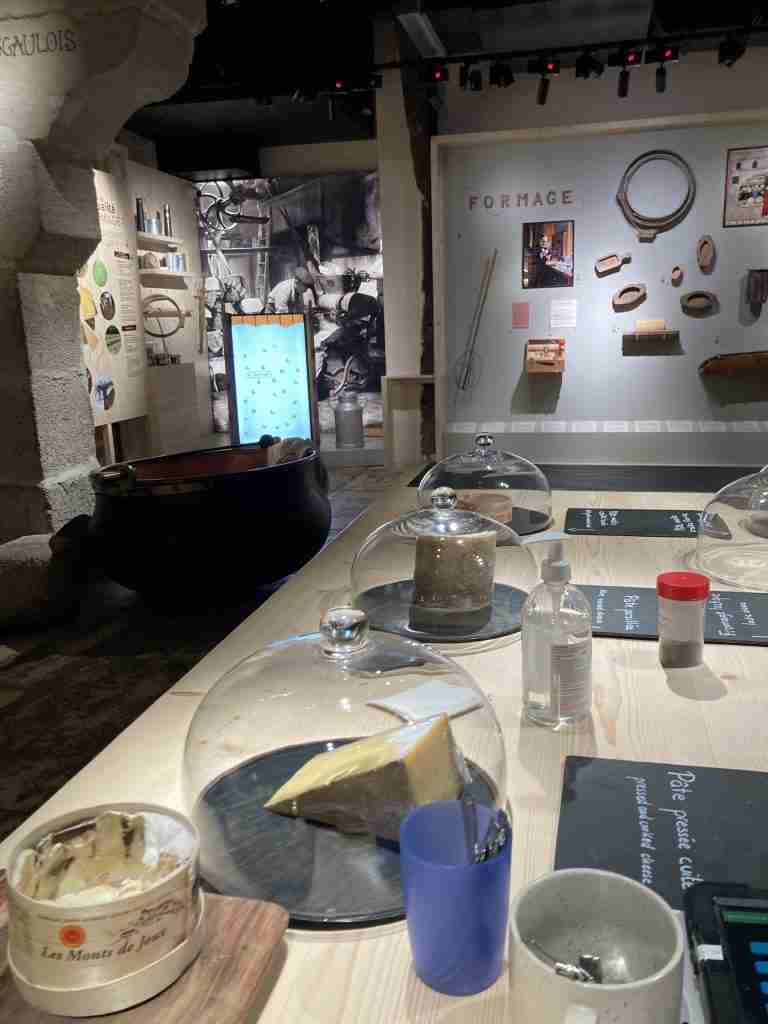
In Review: The Musée Vivant du Fromage, France’s First Cheese Museum

Where to Taste 10 Iconic French Foods & Dishes in Paris

Brief History of Cannelés – & Some of the Best in Bordeaux

French “Bouillon” Restaurants: History & the Best in Paris

A Short History of French and Dijon Mustard

French Candy & Confectionary Shops: History & The Best in Paris

Courtney Traub is the Founder and Editor of Paris Unlocked. She’s a longtime Paris resident who now divides her time (as well as she can manage) between the French capital and Norwich, UK. Co-author of the 2012 Michelin Green Guide to Northern France & the Paris Region, she has been interviewed as an expert on Paris and France by the BBC, Australian Broadcasting Corporation, Le Figaro, Matador Network and other publications. Courtney has also written and reported stories for media outlets including Radio France Internationale, The Christian Science Monitor, Women’s Wear Daily and The Associated Press. In addition to going down various rabbit holes of curiosity when it comes to French culture, history, food and art, Courtney is a scholar of literature and cultural history whose essays and reviews have appeared in various forums.
