
Last Updated on December 29, 2025

Well, I finally took the plunge. After years of avoiding it, I recently eked out some time on a Sunday morning to watch a three-part documentary I knew would leave me in tears.
It’s a documentary that revisits, in chilling and deeply personal detail, the terrorist attacks of November 13th, 2015 that shook Paris (and the rest of France) to its core, leaving 130 people dead and hundreds more injured.
Drawing almost exclusively on intimate, devastating testimonials from survivors and first responders, November 13: Attack on Paris is less a traditional documentary than it is a means of giving voices, and faces, to the people who witnessed terror and inhumanity, and lived to tell the tale. It’s also a moving yet brutal tribute to those who did not.
Across three harrowing episodes, it runs us through what started out as a joyful, warm and dry November evening in Paris, which drew out crowds to occupy the terraces of cafés and bars. A football match at the Stade de France between France and Germany is fully packed with spectators, while many others gather in bars to watch the match for a fun Friday out with friends and family.
But the joy quickly turns to horror and death. A group of terrorists who later claimed affiliation with the Islamic State (ISIS) carry out a quick succession of premeditated but seemingly random attacks outside the Stade de France north of the city, then at a series of bars and restaurants in Paris’ 10th and 11th arrondissement, around the Canal St Martin and Bastille, and culminating in a bloody assault at a popular concert hall in the same neighborhood.
We hear from the survivors and first responders at each of the sites in the capital targeted that night. One emergency care worker at the Goncourt Hospital, near the Canal St. Martin, had gone out with friends and colleagues to the nearby Le Carillon bar after work.
Suddenly, rapidfire shots ring out, and he falls to the ground. Not looking up, he tells himself he should think of something. “What will your final thought be?” he recalls asking himself.
But his mind is entirely blank. When the gunfire abates, the attackers flee and he looks up, he sees a man slumped in a chair. Their eyes meet— then the man dies in front of his eyes. 15 people were massacred at the bar that night, and 15 critically injured.
At the nearby La Belle Equipe, 19 people lost their lives in an attack shortly thereafter, and many more were severely injured. A server recounts that there was a terrifying silence at the bar, aside from the sound of rapidfire shooting. “There was the silence…of no one crying out. And then, suddenly, the odor of blood,” she says, tears in her eyes.
At the same bar, owner Grégory recounts how he survived the attack, but lost his wife Djamila, who had been serving customers on the terrace where the terrorists targeted the greatest number of people. She died in his arms, having suffered from an internal hemmhorage. “She didn’t want to scare me,” he says, his voice full of grief. “She knew me that well”.
A long section of the series revisits the attack on the Bataclan concert hall, a massacre that left 90 people dead and nearly as many injured. A rock concert had sold out, and the hall was packed with some 1,500 spectators.
It’s horrifying to see live footage of the concert, interrupted by the chilling sound of Kalashnikov-type assault rifles being fired into the crowd. The ordeal that follows is far worse. Dozens are gunned down, while others, including some of the interviewees in the series, lie on the ground and“play dead” in the orchestra pit, attempting to hide among the massacred. One recounts holding the hand of his girlfriend, only to feel her hand grow rigid and cold, as he realizes that she’s lost her life.
A small group of strangers, many young couples with children waiting at home, are taken hostage and recount their ordeal at the hands of the terrorists, who seem to have no plan and no particular demands. Their testimonials seem to underline both the absurdity and even amateurish-ness of the attacks.
Across all three hours, we come to vividly inhabit the perspectives of the survivors and first responders, feeling in turn their fear, their disbelief, their desperate desire to see their children again, their fight to survive the night. Their relief, and sometimes guilt, at coming out of the attacks to tell their stories. There’s very little music, and almost no narration. It’s a real exercise in human empathy, in bearing witness to the pain of others.
What the series refuses to do— and some might see this as a flaw— is give much context at all to the attacks themselves, the twisted rationale behind them, or the radicalization of the individuals (only named in passing by certain survivors) who planned and executed the attacks.
While most documentaries about terrorist attacks spend a good deal of time analyzing the psychology of terror, the grim path towards radicalization, or the political and social conditions that terrorists often point to to justify their heinous acts, this one refrains from doing all of the above.
It instead resolutely focuses on the victims, survivors, and first responders, as if to suggest that putting much emphasis on the perpetrators and their stated reasons for the attacks would represent an injustice: one against the memory and experience of those they blindly targeted.
It may leave those unfamiliar with what happened that night wanting more context. But I applaud the approach of the filmmakers, brothers Jules and Gédéon Naudet, in going a diffrerent way. Besides, facts about the terrorists, and how they plotted and carried out the attacks, is readily available on the web and elsewhere— not least because a highly publicized trial is underway in France.
Mourning & Bewilderment: An Attack on my Former “Quartier”

Why had I avoided watching this series for so long? And why did I choose to finally hit “play”, confronting my own dread at revisiting these awful events?
The attacks of November 13th hit home, quite literally. For years, I lived in the 11th arrondissement, just blocks away from the bars, restaurants and concert hall where so many people senselessly lost their lives. I had enjoyed drinks at many of the bars that came under attacks, eaten out with friends at Le Petit Cambodge, a restaurant that was targeted that night, and seen concerts at Le Bataclan. I lived at the far end of Rue de la Fontaine au Roi, and one of the bars attacked that night is situated at the other end of my old street.
In short, the events of that night haunt and devastate me in part because it’s all too easy to imagine them happening on some other occasion, perhaps a different Friday night when I and my friends had gathered to chat and enjoy life in Paris. I could all to vividly feel the horror and suffering of those who lost their lives, or who lost loved ones.
And to see the city I love and know better than any other on the planet assaulted for some of its core values— the terrorists specifically targeted people out enjoying themselves and their individual freedoms— was deeply painful.
Of course, just a couple of days later, the terraces were again brimming with people, and Parisians were determined to show that they’d never surrender their joie de vivre, nor give in to fear. There’s a reason why “Fluctuat, Nec Mergitur” (Tossed, but not sunk”) is the city’s motto— and in the aftermath of the attacks, it took on a strong renewed meaning for residents.

But here’s the thing: healing often comes with confronting things head-on, at least in my humble experience. Since watching the series, I think I’ll be able to head back to some of the places where the attacks took place, and enjoy them again without feeling an overwhelming sense of dread and sadness.
And of course, France is currently undertaking its own act of healing and reckoning, with a months-long trial underway at the Palais de Justice in central Paris. Once agains, the families of victims, survivors, and first responders are offering their moving and devastating testimony, and the only attacker who remains alive is taking the stand.
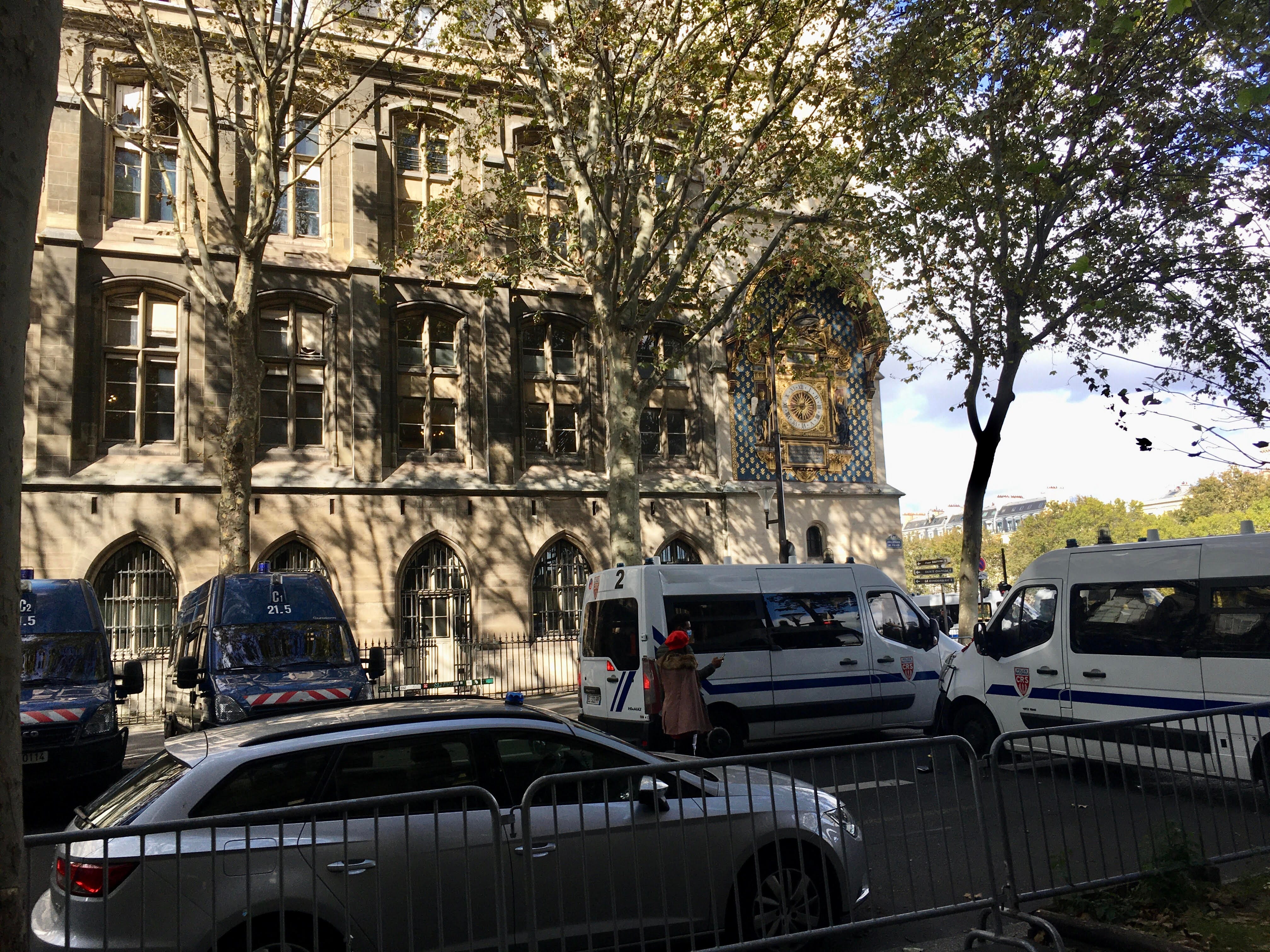
The area around the Palais de Justice is completely blocked off from traffic, and even pedestrians can not get through for several blocks around— a chilling reminder that the trial is vulnerable to would-be attackers. One can only imagine the bravery of the survivors and their families, whose pain in revisiting the inhuman events of November 13 must be acute.
Thanks for reading, and if you manage to see the documentary (out on Netflix worldwide) please don’t hesitate to send me your thoughts at editor@parisunlocked.com.

Courtney Traub is the Founder and Editor of Paris Unlocked. She’s a longtime Paris resident who now divides her time (as well as she can manage) between the French capital and Norwich, UK. Co-author of the 2012 Michelin Green Guide to Northern France & the Paris Region, she has been interviewed as an expert on Paris and France by the BBC, Australian Broadcasting Corporation, Le Figaro, Matador Network and other publications. Courtney has also written and reported stories for media outlets including Radio France Internationale, The Christian Science Monitor, Women’s Wear Daily and The Associated Press. In addition to going down various rabbit holes of curiosity when it comes to French culture, history, food and art, Courtney is a scholar of literature and cultural history whose essays and reviews have appeared in various forums.
