
Last Updated on September 17, 2026
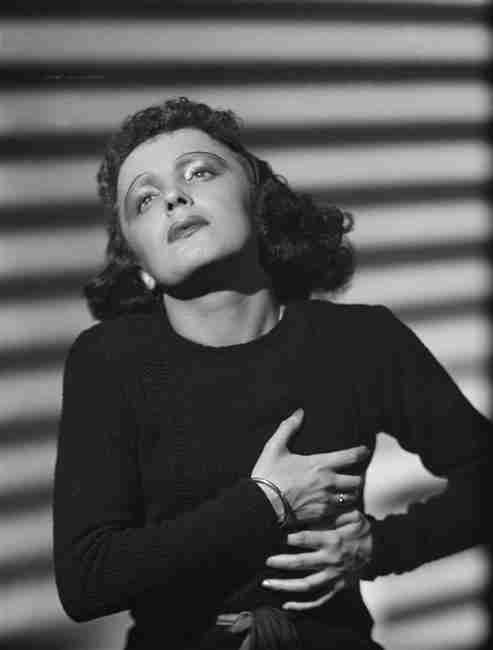
The second installment in our “Great French Icons of the 20th Century” Series
More than a mere diva, Edith Piaf was something of a force of nature. She had an uncanny ability to reach a wide public with her soaring, guttural voice, but also with her odd physical presence. She captivated audiences around the world with her repertoire of French working-class dance hall hits, love songs and portraits of marginalized women, from prostitutes to penniless, unmarried mademoiselles embarking on ill-fated affairs with military men.
{Related at Paris Unlocked: Key Places to Find Edith Piaf’s Traces in Paris}
In this first of two episodes on Piaf, we’ll address some of the holes at the heart of the Piaf myth, in order to, I hope, get at the immensely complex and fascinating woman that she was. So often painted as a tragic figure, she was a survivor. She was an acerbic wit with mad street smarts, an eternal vagabond with an instinct for survival and a conjoined, paradoxical instinct for self-destruction.
See more about The French Culture Podcast here
One thing you won’t get from the two episodes we’ve got lined up on Piaf for this season is a laundry list of her lovers and romantic interests, which is how biographers have too often framed her life, even in relation to her music and the way it evolved over time. Instead, I’ll try to offer some context and background for the working-class musical and social traditions that helped to make Piaf who she was. I also want to highlight how she managed to bring this distinctive Parisian working class vernacular and culture to a global audience through her chansons réalistes— or ‘realistic songs’’.
In these two episodes you’ll also learn about some of her most important artistic collaborations, which led her to not only co-write some of her most memorable songs, but also to star in noteworthy plays and films, form lasting friendships with great composers, poets and performers, and mentor many young musicians over the years.
She was truly passionate about these friends and collaborators, whether they were platonic loves, or also happened to be lovers. So while it’s easy to frame her life around a doomed quest for romantic love, this really doesn’t get at the fact that Edith’s central and most enduring love was probably for her chosen family– and especially for the enduring friendships and collaborators who gave her the sense of continuity and stability she deeply needed. Ultimately, I want to try to address some of the holes at the heart of the Piaf myth, in order to, I hope, get at the immensely complex and fascinating woman that she was. So often painted as a tragic figure, she was a survivor. She was an acerbic with mad street smarts– an eternal vagabond with an instinct for survival and a conjoined, paradoxical instinct for self-destruction.
Watch this episode on YouTube
Show notes
This episode was conceived, written, narrated and edited by Courtney Traub. It was produced by Brendan Whalen, who contributed additional research and script editing. Additional audio editing and sound design was by Engin Hassan of Edit Fade Warp. Artwork for the Paris Unlocked Podcast was created by Mateeya.
If you liked this episode, please follow The French Culture Podcast, and share it as widely as you can.
Follow & listen on Spotify, Rss.com, Apple Music, or Substack
And as I mention at the beginning of the episode, you can also lend your precious support to both the French Culture Podcast and to our sister website and newsletter, Paris Unlocked, by buying us a coffee– or even better, becoming a “Donor Subscriber” on Substack. You’ll get unlimited access to a large archive of Paris and France-related news stories, reviews, audio stories, essays and travel tips, as well as personalized travel advice from me.

Translations of original French quotes in this episode are all by Courtney Traub. All images displayed in the show notes are out of copyright and in the public domain.
The problem of fair use and music clips: As I discuss in the episode, I was unable to secure the rights to Piaf’s music, in order to play short excerpts of the songs I reference in this episode. There is no “safe” amount of a piece of copyrighted music that one can play under fair use laws, so I preferred to be cautious in this regard and include none.
Spotify playlist: Please listen to the songs referred to in this episode by going to the Spotify playlist I’ve put together. It’s less ideal than playing clips from the songs in the episode, but it’s (at the least) a way to listen . If you can, I recommend keeping the playlist open as you listen to the episode, and pausing to play the song being referenced. Of course, please don’t attempt this while driving or operating machinery!
Music credits (all music clips are in the public domain)
Intro and outro: Music by Trygve Larsen from Pixabay (“Erik Satie’s Gnossienne 1 – Classical Remix Piano and Sax”)
Music in order of use throughout episode:
- Music by Mikado Koko from Pixabay (Cool Jazz Session 8″)
- Music by u_bv0j8sxr2s from Pixabay (“Le Parrain de Minuit”)
- Music by Jakob Welik from Pixabay (“Le Cœur de Paris”)
- Music by Jean-Paul Verpeaux from Pixabay (“Bienvenue au Cirque”)
- Music by Jakob Welik from Pixabay (“Etoiles de minuit”)
- “Si tu n’étais pas là, performed by Fréhel. Sheet music published in 1935. Music composed by Gaston Claret, lyrics by Pierre Bayle. Originally published by “Editions Salabert”, Paris, 1935 (Wikimedia Commons (public domain)
- Music by Saturn-3-Music from Pixabay (“Claire de Lune- Débussy)
- Music by Jean-Paul Verpeaux from Pixabay (“Perdu dans Paris”)
- Music by Jean-Paul Verpeaux from Pixabay (“Midnight in Paris”)
- Music by VibeHorn from Pixabay (“French Paris Romantic Music”)
Sources for this episode
For this episode, we consulted a variety of print and online primary sources, including books, newspaper articles, blogs, documentaries, film clips and archival documents. They are presented in relative order of importance and/or order in which their information appears in the episode, rather than in alphabetical order. Sources are both in English and French; where available, I have also linked to the English-language version of the source.
- Carolyn Burke, No Regrets: Edith Piaf. Bloomsbury, 2012.
- David Loosely, Edith Piaf: A Cultural History. Liverpool University Press, 2015. Available online in open source: https://library.oapen.org/bitstream/handle/20.500.12657/26016/1004069.pdf
- David Bret, Edith Piaf: Find Me a New Way to Die. Oberon Books, 2015.
- Albert Bensoussan, Édith Piaf. Gallimard: 2013 (French-language paperback)
- Robert Belleret, Piaf: Un Mythe Francais. Fayard, 2013.
- David Conley McKinney, “The Influence of Parisian Popular Entertainment on the Piano Works of Erik Satue and Francis Poulenc”, The University of North Carolina at Greensboro, 1994 (unpublished PhD dissertation), https://libres.uncg.edu/ir/uncg/f/McKinney_uncg_9502709.pdf
- “Sans Amour on n’est rien du tout”, (Documentary). Arte, 2003, directed by Marianne Lamour. Available on YouTube: https://www.youtube.com/watch?v=1fpwQYd_OwM&list=WL&index=4
- Maylis Besserie, “A la conquète de l’Amérique”, from the series “La Vie en Piaf”, Radio France, 25 July 2013, https://www.radiofrance.fr/franceculture/podcasts/la-vie-en-piaf/a-la-conquete-de-l-amerique-1947-1959-5579008
- A.J. Liebling, “Edith Piaf’s Thousand (Delightful) Ways to Bum You Out”, The New Yorker, November 8, 1947, https://www.newyorker.com/magazine/2022/08/29/edith-piafs-thousand-delightful-ways-to-bum-you-out
- Edith Piaf, Ma Vie, Union Générale d’Editions, 1964. Available at the Internet Archive: https://archive.org/details/mavie0000piaf/page/12/mode/2up
- Cécile Hamsy, “Belleville Village”, France Culture (radio program), 27 September 2025, https://www.radiofrance.fr/franceculture/podcasts/les-nuits-de-france-culture/belleville-village-8393284
- “Belleville au début du XXême siecle”, Paris ZigZag, no date, no author. https://www.pariszigzag.fr/insolite/histoire-insolite-paris/belleville-au-debut-du-xxe-siecle/
- “Quelle est la tombe la plus visitée au Père-Lachaise?”, Perelachaise.com, no date, https://pere-lachaise.com/tombe-la-plus-visitee-au-pere-lachaise/
- Demi Perera, “‘It’s an archive of Paris’: Why you should visit Père-Lachaise cemetery – with Edith Piaf among famous graves”, The Independent, 11 April 2025, https://www.independent.co.uk/travel/europe/france/paris/pere-lachaise-paris-cemetery-jim-morrison-edith-piaf-b2725908.html
- Frantz Vaillant, “Piaf? Une Enfant-Dictateur”, TV5 Monde, 10 October 2013, https://information.tv5monde.com/international/piaf-une-enfant-dictateur-20140
- Richard R. Lingeman, “Piaf. by Simone Berteaut”, The New York Times, 28 July 1972, https://www.nytimes.com/1972/07/28/archives/sad-songs-of-the-sparrow.html
- Paul Morelle, “‘Piaf’”, par Simone Berteaut”’, Le Monde, 6 September 1969, https://www.lemonde.fr/archives/article/1969/09/06/piaf-par-simone-berteaut_2432170_1819218.html?search-type=classic&ise_click_rank=7
- Susan Heller Anderson, “Piaf Remains a Mix of Myth and Reality”, The New York Times, 22 February 1981, https://www.nytimes.com/1981/02/22/arts/piaf-remains-a-mix-of-myth-and-reality.html
- “Edith Piaf dans ‘La Garconne’ (1936)’’. Edith Piaf (YouTube channel), no date, https://www.youtube.com/watch?v=-r_DkxCM68Y
- “Lundi 6 avril 1936: Louis Leplée assassiné”, Paris Visites, no date, http://paris.visites.jpkmm.free.fr/faits_divers/38_leplee.html
The French Culture Podcast: Season 1, Episode 2 – The Radically Colorful World of Henri Matisse
The French Culture Podcast: Season 1, Episode 4 – Edith Piaf, Part 2

The French Culture Podcast: Season 1, Episode 5 – Josephine Baker

Courtney Traub is the Founder and Editor of Paris Unlocked. She’s a longtime Paris resident who now divides her time (as well as she can manage) between the French capital and Norwich, UK. Co-author of the 2012 Michelin Green Guide to Northern France & the Paris Region, she has been interviewed as an expert on Paris and France by the BBC, Australian Broadcasting Corporation, Le Figaro, Matador Network and other publications. Courtney has also written and reported stories for media outlets including Radio France Internationale, The Christian Science Monitor, Women’s Wear Daily and The Associated Press. In addition to going down various rabbit holes of curiosity when it comes to French culture, history, food and art, Courtney is a scholar of literature and cultural history whose essays and reviews have appeared in various forums.
